This tutorial shows how to handle JSON body data of HTTP PUT request in Spring MVC
Example
The controller
package com.logicbig.example;

import org.springframework.beans.factory.annotation.Autowired;
import org.springframework.stereotype.Controller;
import org.springframework.ui.Model;
import org.springframework.web.bind.annotation.*;

@Controller
@RequestMapping("/articles")
public class ArticleController {

    @Autowired
    private ArticleService articleService;

    @GetMapping
    public String getArticleForm() {
        return "article-form";
    }

    @PutMapping(value = "/{id}")
    @ResponseBody
    public String createNewArticle(@RequestBody Article article) {
        articleService.saveArticle(article);
        return "Article created.";
    }

    @GetMapping(value = "/{id}")
    public String getArticle(@PathVariable("id") long id,
                             Model model) {
        Article article = articleService.getArticleById(id);
        model.addAttribute("article", article);
        return "article-page";
    }
}
package com.logicbig.example;

public class Article {
    private long id;
    private String content;
    .............
}
JSP Pages
src/main/webapp/WEB-INF/views/article-form.jsp<html>
<head>
<script src="https://ajax.googleapis.com/ajax/libs/jquery/3.3.1/jquery.min.js"></script>
</head>
<body>
<h3>HTTP PUT request with JSON Body Example</h3>
<form id="article-form">
<pre>
id: <input type="text" name="id">
content: <input type="text" name="content">
<input type="submit" value="Submit">
</pre>
</form>
<br/>
<div id="result"></div>
<script>
$("#article-form").submit(function(event){
event.preventDefault();
var form = $(this);
var idVal = form.find('input[name="id"]').val();
var contentVal = form.find('input[name="content"]').val();
var url = 'http://localhost:8080/articles/'+idVal;
var jsonString = JSON.stringify({id: idVal, content: contentVal});
console.log(jsonString);
$.ajax({
type : 'PUT',
url : url,
contentType: 'application/json',
data : jsonString,
success : function(data, status, xhr){
$("#result").html(data+
" link: <a href='"+url+"'>"+url+"</a>");
},
error: function(xhr, status, error){
alert(error);
}
});
});
</script>
</body>
</html>
src/main/webapp/WEB-INF/views/article-page.jsp<html>
<body>
<h3>Article</h3>
${article}
</form>
</body>
</html>
Additional JSON dependency
pom.xml<dependency>
<groupId>com.fasterxml.jackson.core</groupId>
<artifactId>jackson-databind</artifactId>
<version>2.9.2</version>
</dependency>
Java Config
package com.logicbig.example;

import org.springframework.context.annotation.Bean;
import org.springframework.context.annotation.ComponentScan;
import org.springframework.context.annotation.Configuration;
import org.springframework.web.servlet.ViewResolver;
import org.springframework.web.servlet.config.annotation.EnableWebMvc;
import org.springframework.web.servlet.config.annotation.WebMvcConfigurer;
import org.springframework.web.servlet.config.annotation.ViewResolverRegistry;
import org.springframework.web.servlet.view.InternalResourceViewResolver;

@EnableWebMvc
@Configuration
@ComponentScan
public class MyWebConfig implements WebMvcConfigurer {

    @Override
    public void configureViewResolvers(ViewResolverRegistry registry) {
    registry.jsp("/WEB-INF/views/", ".jsp");
    }
}
Output
To try examples, run embedded Jetty (configured in pom.xml of example project below):
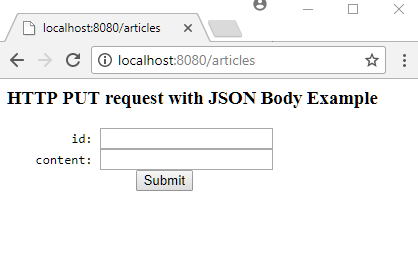
mvn jetty:run Accessing http://localhost:8080/articles:
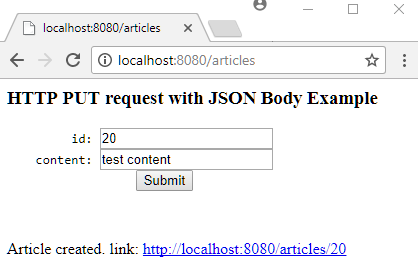
Filling up and submitting the form:
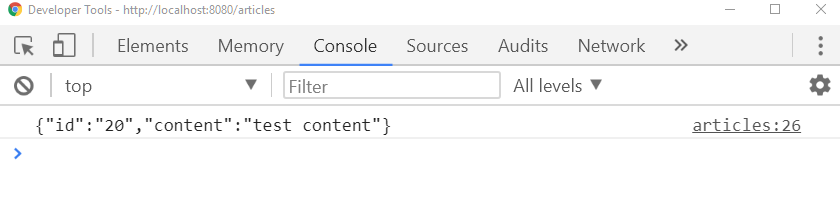
In Chrome's developer tools window, we will see the logs:
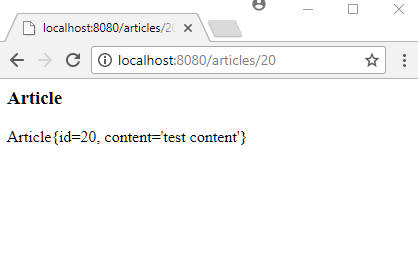
Clicking on the hyper link of the article:
Using curl
$ curl -s -X PUT "http://localhost:8080/articles/2" -H "Content-Type: application/json" -d "{\"id\":\"2\",\"content\":\"test content\"}"
Article created.
$ curl -s "http://localhost:8080/articles/2"
<html>
<body>
<h3>Article</h3>
Article{id=2, content='test content'}
</form>
</body>
</html>
Example ProjectDependencies and Technologies Used: - spring-webmvc 7.0.6 (Spring Web MVC)
Version Compatibility: 3.2.9.RELEASE - 7.0.6 Version compatibilities of spring-webmvc with this example: Versions in green have been tested.
- jackson-databind 3.0.0 (General data-binding functionality for Jackson: works on core streaming API)
- jakarta.servlet-api 6.1.0 (Jakarta Servlet API documentation)
- jakarta.servlet.jsp.jstl 3.0.1 (Jakarta Standard Tag Library Implementation)
- JDK 25
- Maven 3.9.11
|