In modern AI development, an Intent Classifier acts as the "receptionist" or "intelligent router" for your application. It is the layer that sits between the user's natural language and your backend code.
The Router: Connecting LLMs to Your Code
As a developer, you don't want an LLM to just "chat" with your users when they need a specific action performed, like processing a refund. Instead, you use the LLM as a Router. The LLM analyzes the user's request and outputs a predefined "slug" or "label" (like REFUND_REQUEST). Your Java or Python code then takes that label and triggers the specific function needed to handle that business logic.
Why AI? Handling the Chaos of Human Language
The true power of using AI for classification is its ability to handle Semantic Variation. Humans rarely speak in a way that is easy for traditional code to understand. AI excels at interpreting:
- Slang: "I want my dough back" vs. "I would like a refund."
- Typos: "Cncel my oredr" vs. "Cancel my order."
- Different Wordings: "Where is my stuff?" vs. "Track my package."
Regardless of how the user words it, the AI understands the "vibe" and returns the exact predefined classifier your code expects.
How We Did This Before AI: The Era of Regex
Before Large Language Models, developers primarily used Regular Expressions (Regex) or keyword matching to route requests. While fast, this was incredibly brittle.
Example of the "Old Way":
if (input.contains("cancel") && input.contains("order")) { return CANCEL_ORDER; }
If the user said, "Stop my delivery," the code above would fail because it didn't find the specific words "cancel" or "order." Developers had to maintain massive libraries of keywords and patterns, which were impossible to keep up-to-date.
Example: The Order App
Imagine you are building an AI assistant for a food delivery app. You program the AI to only output one of four specific labels. Here is how it handles different inputs:
To understand how an Intent Classifier works in practice, let's look at how our "Order App" processes different types of human speech into specific system actions.
Example 1: Checking Status
User Input: "Where is my pizza? It's been an hour!"
AI Intent: CHECK_ORDER
System Action: The backend receives the label and triggers the GPS tracking API to locate the driver.
Example 2: Cancellation
User Input: "I changed my mind, stop the delivery."
AI Intent: CANCEL_ORDER
System Action: The system runs a check to see if the kitchen has started cooking; if not, it halts the order.
Example 3: Refund Request
User Input: "The food was cold, I want my money back."
AI Intent: REFUND_REQUEST
System Action: The system automatically opens a high-priority support ticket for the kitchen manager.
Example 4: Out of Scope
User Input: "Is it going to rain today?"
AI Intent: UNKNOWN
System Action: The AI recognizes this is not about food and replies: "I can only help with orders; I don't have weather data."
By forcing the AI to return these specific labels, you turn an "unpredictable chatbot" into a "predictable software interface."
Practical Interaction: From Human Speech to Code Label
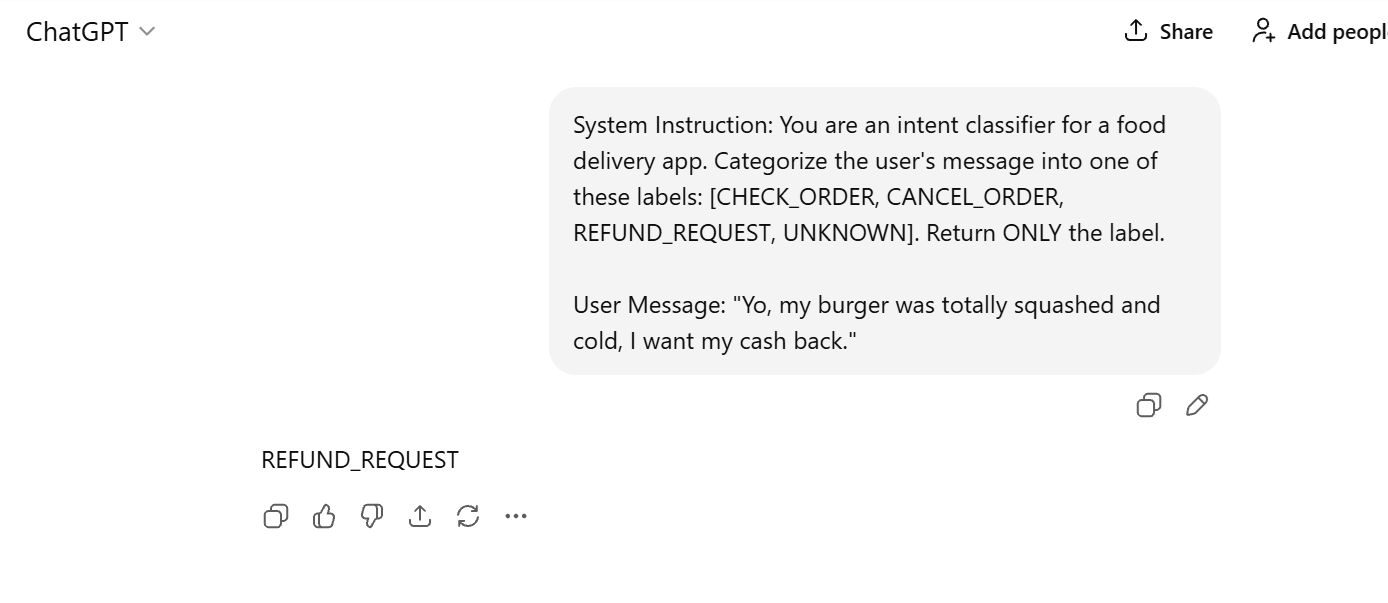
To use an LLM as a classifier, you don't just send the user's message. You wrap it in a System Instruction that tells the AI to act as a logic gate. Here is exactly what that interaction looks like.
The Developer's Prompt
System Instruction:
    You are an intent classifier for a food delivery app.
    Categorize the user's message into one of these labels:
    [CHECK_ORDER, CANCEL_ORDER, REFUND_REQUEST, UNKNOWN].
    Return only the label.
User Message:
    "Yo, my burger was totally squashed and cold, I want my cash back."
Sending message to LLM
We combine above two and send a single message to LLM.
In the following screenshot we are using Chat GPT.
Now, your Java or Python code can use a simple switch or if statement to route the logic.
Why this is a Developer "Superpower"
Notice that the LLM understood that "squashed and cold" and "cash back" combined to mean a REFUND_REQUEST. In the past, you would have had to write hundreds of lines of code to catch all those variations; now, the LLM handles the "understanding" and your code handles the "execution."
A Java Example
Please check out our Java example on Intent Classification.
|